



The Death of Low-Value Content: Why AI Inflation Requires Human Authenticity
 February 03, 2026
'Human-in-the-Loop' FAQs
Does Google automatically penalize a piece of content just because AI was used to write it?
What exactly did Google change in its late 2025 updates regarding content quality?
How can we optimize our content so that AI search engines actually cite our brand?
Creating an abundance of content with little effort or originality with no editing or manual curation is often the defining attribute of spammy websites… Pages and websites made up of content created at scale with no original content or added value for users, should be rated Lowest, no matter how they are created1.
Imagine finding a magical pasta maker. You press a button, and boom—perfect fettuccine twists out of the slot. Fascinated by this effortless carbohydrate factory, you decide to leave it running overnight. You wake up the next morning, open your front door, and find your entire neighborhood buried under a six-foot avalanche of identical, lukewarm, unseasoned noodles.
The Ghost in the Content Machine: Why ‘Human-in-the-Loop’ Pipelines Outperform 100% Automated SEO
It’s a massive mess, it smells faintly of cardboard, and frankly, nobody wants to eat it.
This is precisely what the internet looks like in 2026. When generative AI hit the mainstream, brands treated it like that automated pasta maker. They spun up 100% automated content pipelines, churning out thousands of flawless, syntactically perfect, completely hollow articles every week to catch search traffic.
But Google just pulled the plug on the pasta machine.
Through consecutive algorithmic shifts—culminating in major system overhauls and the defining December 2025 Helpful Content Update—the search giant has made one thing explicitly clear: unsupervised, mass-automated AI content is an express ticket to digital invisibility2.
At Webjutsu Digital Media, we’ve always believed that technology should elevate human genius, not replace it. The numbers are finally back from the front lines, and they prove that a “Human-in-the-Loop” (HITL) content strategy doesn’t just beat pure automation—it obliterates it. Let’s dive into why the algorithmic tides have turned, and why human hands are your brand’s ultimate competitive edge.
The Landscape: Contextualizing Google’s War on “Experience Dilution”
To understand why pure automation fails, we have to look at what Google’s engineers are trying to fix. The web is facing an existential crisis of “experience dilution”. Generative AI tools are incredibly adept at scraping existing data, rephrasing it, and outputting an article that looks highly professional3.
The catch? It’s completely unoriginal. It is the echo of an echo.
Google’s response has been a series of aggressive updates to its Search Quality Rater Guidelines. The January 2025 update explicitly instructed its 16,000 human quality raters to flag websites utilizing “scaled content abuse”—defined as mass-producing content with little to no manual curation or editing—and hand them the “Lowest” possible quality rating4.
Then came the hammer of the December 2025 update. This shift bypassed simple AI detection (which is notoriously unreliable anyway) and focused instead on punishing sites that lack genuine, first-hand expertise. If your content simply repeats the same ten generic tips found on every other site on the web, Google’s systems now recognize that lack of depth and suppress your visibility3.
Why Purely Automated Pipelines Crash (The Data)
Let’s look at the hard evidence. When a brand relies on an unsupervised AI pipeline, it forgets that AI models are inherently backward-looking; they predict the next best word based on past data. They cannot step into the real world, interview a software engineer, or run a product test.
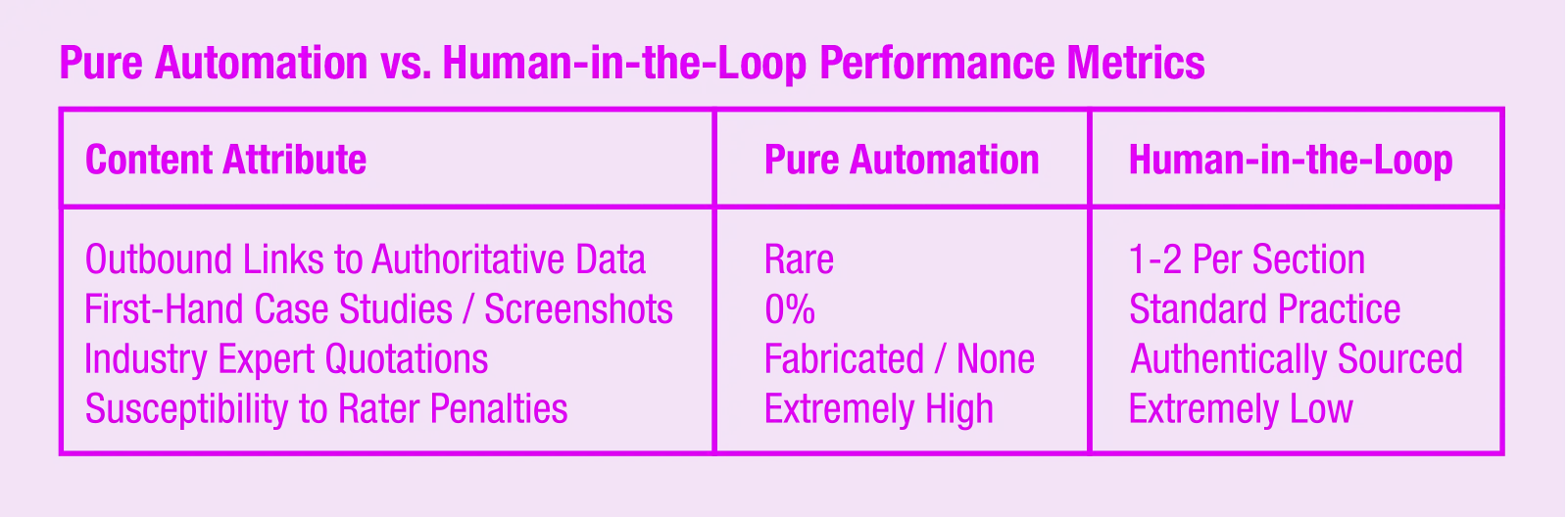
The fallout of ignoring this is measurable. Case studies tracking the aftermath of recent core updates show that sites relying purely on automated, unverified content experienced devastating traffic drops during algorithm rollouts. Because AI tools frequently produce wordy text stuffed with subtle filler, they trigger Google’s newly refined “filler content” filters, which are designed to hunt down low-substance pages3.
Furthermore, search behavior itself has fractured. With Google AI Overviews capturing a massive chunk of traditional informational real estate, organic click-through rates (CTR) for standard position-one slots have dropped significantly. HubSpot research reveals that AI Overviews now cut organic CTR by an average of 58% to 61% for many queries.
If your content is a generic AI rewrite, you lose twice: Google’s AI won’t cite you because you offer no unique data, and human searchers won’t scroll down to click your link because the AI summary already answered their basic question.
The Human-in-the-Loop Counter-Offensive
A Human-in-the-Loop strategy treats AI as a brilliant, lightning-fast research intern, but keeps a human expert firmly in the Editor-in-Chief chair. The AI builds the skeleton; the human injects the soul, the heartbeat, and the proof1.
Here are the three structural pillars where HITL pipelines consistently outpace the machines:
-
1. The Integration of “Demonstrable Expertise Markers”
An AI can write a beautifully structured paragraph about email marketing optimization. What it cannot do is add a sentence like: “When we tested this exact subject line variation across 1,200 active client accounts at Webjutsu last month, our open rates spiked by 14.2%3.”
Google’s latest search quality updates actively hunt for these messy, real-world practitioner details. By adding specific tool names, authentic screenshots, and proprietary case numbers, a human editor instantly elevates a generic article into a high-E-E-A-T powerhouse3. -
2. Sourcing Irresistible “AI Citations”
To win traffic in 2026, you want your content to be the primary source that search engine LLMs fetch and quote. How do you do that? By building a framework of trust.
Data shows that content capturing citations in AI search interfaces almost always includes high-quality outbound links to trusted domains, robust statistics, and direct expert quotes. A human editor naturally weaves these network elements together, whereas a pure AI pipeline left to its own devices either hallucinates references or ignores them entirely. -
3. Structural Fluency and Scannability
A human editor reads with empathy; we know exactly when a reader is getting bored or when an explanation feels like a dense block of drywall. By utilizing clean semantic blocks (structuring content into concise 200–400 word sections with clear headings and explicit Q&A formats), human editors optimize text for Retrieval-Augmented Generation (RAG). We reshape the raw AI text to be deeply satisfying to both the human eye and the machine crawler.
The Bottom Line for Brands
Relying on a 100% automated content pipeline is like trying to build a brick-and-mortar store out of painted cardboard. It’s cheap, it goes up incredibly fast, but the moment a storm hits, the entire structure dissolves into mush.
The core update trends of the past year aren’t an attack on artificial intelligence; they are a passionate defense of genuine human value. If you want your business to build an unshakeable digital footprint, you have to invest in the human touch. Use the machines to clear the field, but let your experts sow the seeds.
- “In-depth analysis of Generative AI / AI content in the Google human quality rater guidelines.” Fullstackoptimization, (2025, January). https://fullstackoptimization.com
- “Google quality raters guidelines update: What E-E-A-T, YMYL & AI now mean for your SEO.” SEO-Kreativ, (2025, September). https://seo-kreativ.de/en/blog
- “Google’s December 2025 helpful content update hit your site? Here’s what actually changed” Synergist Digital Media, (2025, December). https://dev.to/synergistdigitalmedia/
- “Google search quality rater guidelines: Key insights about AI use.” Originality.AI, (2025, October). https://originality.ai