



Zero-Click Searches: How to Measure Marketing ROI When No One Visits Your Site
 April 06, 2026
Zero-Click SEO FAQs
If users are getting their answers directly from AI summaries without clicking, how does a brand make money from a zero-click search?
How can our marketing team track our "Share of Intelligent Answer" or AI Citation Rate?
Does a drop in total organic sessions mean our SEO and web development strategies are failing?
The blue link is dying as a discovery mechanism for informational queries. The metric of success must shift from Click-Through Rate (CTR) to Brand Recall. Did the user see your name? Did the AI position you as the authority?
Imagine you own a bustling, high-end brick-and-mortar storefront. For years, your definition of success has been simple: how many physical bodies walked through your glass doors today? You tracked the foot traffic, counted the heads, and correlated those numbers directly to your revenue.
Now, imagine a highly efficient personal shopping concierge sets up a desk right on the sidewalk outside your store. When a customer walks up with a question, the concierge flips through a massive guidebook, extracts the exact answer, and hands it to the customer. The customer smiles, gets exactly what they need, and walks away without ever crossing your threshold.
If your sole metric for business health is foot traffic inside the building, you are currently in a state of absolute panic. You think your business is dying.
But here’s the twist: the guidebook the concierge is using? It was written entirely by you. Your brand name is printed in bold ink at the bottom of every answer, and the customer leaves associating your name with ultimate authority.
This is the exact paradigm shift facing digital marketing managers.
With the explosive integration of Google AI Overviews, ChatGPT Search, and Perplexity, the user journey has fundamentally changed. We have firmly entered the “Zero-Click” era, where more than half of all informational search queries are fully satisfied directly on the search engine results page (SERP) without a user ever clicking through to a website. For marketing teams stubbornly clinging to legacy metrics like sessions and pageviews, this isn’t just an existential crisis—it’s a massive strategic blind spot1.
At Webjutsu Digital Media, we’re helping forward-thinking brands throw out the outdated 2020 analytics playbook. It’s time to stop measuring mere visits and start measuring influence. Here is your operational blueprint for transitioning from traditional traffic metrics to the new gold standard of digital marketing: Brand Citation Metrics2.
The Hard Truth: The Extinction of the Informational Click
Let’s look at the numbers. The traditional funnel is collapsing because AI has transformed the user from an active web explorer into a passive consumer. Instead of opening five separate tabs to compare software or research a business strategy, users simply ask an AI engine to “synthesize the pros and cons”.
The resulting data from early 2026 paints a stark picture:
- The Organic Evaporation: Informational queries that trigger an AI Overview suffer a staggering 58% to 61% drop in organic click-through rates compared to traditional search results3.
- The AI Lockdown: For queries where an AI Overview is generated, the zero-click rate skyrockets to approximately 83%. That means eight out of ten users get their answers entirely on-SERP2.
- The Death of the Volume Game: Traditional top-of-funnel blog posts designed to capture massive, casual search volume are generating fractions of the traffic they used to4.
If you judge your marketing team’s ROI solely on Google Analytics 4 (GA4) total sessions, your reports are going to look terrifyingly red. But visibility without a immediate click is far from valueless; it is a high-impact, programmatic branding opportunity. The goal of modern Generative Engine Optimization (GEO) is to pivot from chasing raw traffic to chasing systemic influence.
The New KPIs: Tracking Your Brand’s Extraction Score
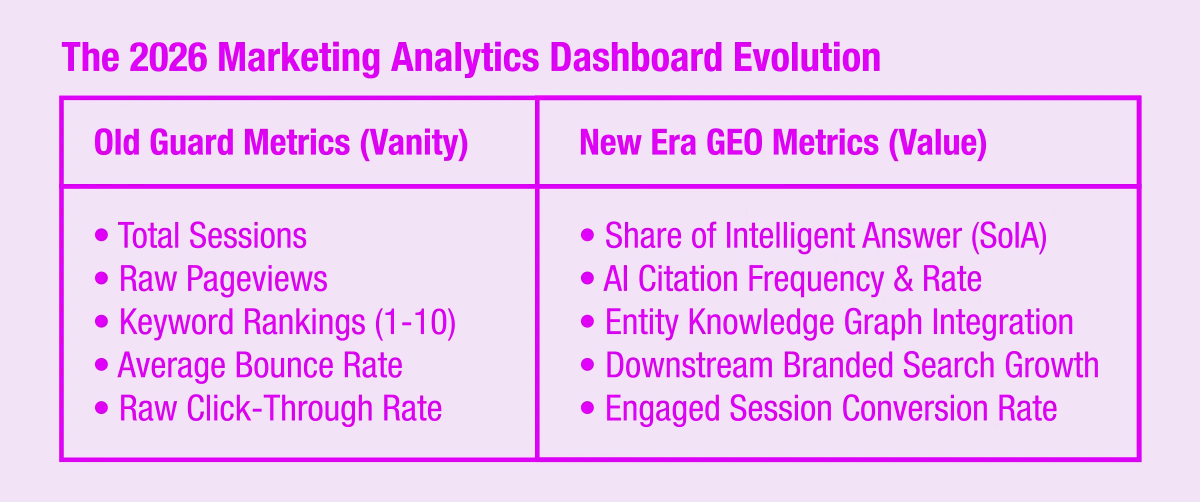
To build an accurate dashboard in an AI-driven ecosystem, marketing managers must embrace a new suite of KPIs that measure what truly matters: authority, machine trust, and downstream impact.
-
1. Share of Intelligent Answer (SoIA)
Think of Share of Intelligent Answer (SoIA) as the modern evolution of “Share of Voice”. This metric measures the percentage of AI-generated summaries where your brand or website is explicitly cited as a trusted source for a specific group of industry keywords3.
If an AI engine creates a summary answering how to scale a B2B SaaS company, does your domain appear in the link bubbles? A high citation rate in AI Overviews is the new “ranking number one”. It is a direct proof-of-concept that the machine’s neural network recognizes your content as the definitive truth on that topic4. -
2. Entity Graph Integration & Extraction Score
AI models don’t think in loose keywords; they think in interconnected entities. Your company, your founders, your core proprietary frameworks, and your primary products need to exist as clearly defined entities within search engine knowledge graphs3.
Your dashboard should track how effectively AI engines connect your brand entity to relevant high-intent concepts. When an AI is asked to recommend the “most secure web development frameworks,” does it automatically map your agency to that concept?4 -
3. Downstream Branded Search Volume
When a user sees your brand name cited by an AI engine as the definitive authority on a complex topic, it triggers a psychological phenomenon known as downstream traffic. The user consumes the answer on the SERP, registers your brand name as the trusted source, and then later skips the informational search entirely to search for your brand name directly1.
Therefore, a drop in generic blog post sessions is often counterbalanced by a spike in branded search volume and direct website traffic. This “assist value” is completely invisible in GA4 unless you intentionally correlate your AI visibility metrics against your direct traffic streams.3
How to Operationalize the Transition
Shifting your marketing culture away from traffic volume and toward citation authority requires a tactical transition in how you develop and measure content.
Stop Tracking “Total Sessions”—Start Tracking “Engaged Sessions”
Raw, accidental traffic numbers are a vanity metric. Instead, focus heavily on Engaged Sessions in Google Analytics 4 (GA4) — sessions that last longer than 10 seconds, feature multiple page interactions, or trigger key conversion events4.
Because casual users are now self-selecting out by using AI summaries, the traffic that does click through to your site possesses incredibly deep intent. They’ve already consumed the baseline AI overview; they are visiting your site because they want a deep dive or are ready to complete a transaction. Consequently, while your traffic volume might decrease, your conversion rates from organic search should climb significantly2.
Build “Click-Gap” Content
To pull users out of the AI’s walled garden and onto your website, you must intentionally engineer a “click-gap”. Give the AI engine exactly what it needs to cite you—clean, declarative, [Subject] is [Predicate] sentence structures packed with unique statistics. Give the AI the What so it can easily extract it for the SERP summary1.
Then, leave the deep, interactive execution—the How—on your website. For instance, structure your page so the AI extracts: “The Webjutsu UX Method scales e-commerce checkout speed by 40%.” The user reads that on the SERP, looks at the citation link, and clicks through to access the actual proprietary calculator or interactive design tool that lives exclusively on your domain.
Moving Forward with Webjutsu
The digital marketing landscape isn’t shrinking; it’s simply moving onto a different plane of geometry. Marketing managers who continue to judge their agency’s success purely by legacy, empty pageview metrics will find themselves optimizing for a web that no longer exists.
By partnering with Webjutsu Digital Media, we ensure your technical web development, structured schema markup, and advanced data pipelines are explicitly built to feed the internet’s new gatekeepers: the AI engines. Let’s stop counting the superficial crowds outside your door and start building the unshakeable digital authority that commands the entire market. Contact us and get started today!
- “Zero-click SEO strategy 2026: How to survive AI overviews 2026” ClickRank AI, (2026, January). https://clickrank.ai/
- “Is SEO dead in 2026? No, but brands still playing by 2020 rules are.” Search Engine Optimized Marketing Agency (SEOMA), (2026, March). https://searchengineoptimizedmarketingagency.com/
- “What is answer engine optimization? And how to do it.” Yotpo, (2026, March). https://yotpo.com/blog/
- “AI SEO and GEO metrics | Essential KPIs for AI search.” IBeam Consulting, (2025, September). https://ibeamconsulting.com/blog/