



The Rise of "Intelligent" UI: Interfaces That Adapt in Real-Time
 December 02, 2025
Dynamic UI FAQs
Does dynamic UI layout swapping hurt a website's SEO or search engine indexation?
How fast do these layout adjustments happen? Will users experience a jarring screen flicker?
What is the average expected return on investment (ROI) for transitioning from a static layout to an adaptive UI setup?
Seventy-one percent of consumers expect companies to deliver personalized interactions. And seventy-six percent get frustrated when this doesn’t happen… Companies that grow faster drive 40 percent more of their revenue from personalization than their slower-growing counterparts.1
Imagine walking into your favorite restaurant. The maître d’ doesn’t just greet you; they instantly recognize that you’re in a rush today because of your brisk pace and your work attire. Before you even sit down, the dining table dynamically changes shape—swapping out the long, romantic multi-course menu for a quick-service tablet highlighting express lunches. The lighting sharpens so you can read your notes, and the noise-canceling acoustics over your booth dial up so you can take a quick call.
You didn’t say a single word. The environment simply looked at your entry signals, deduced your core intent, and re-engineered itself to make your life effortless. You order, you pay, and you leave completely delighted.
Now, contrast that with the current state of digital marketing landing pages.
Most websites treat every single visitor like the exact same person. Whether an executive arrives from a high-intent enterprise Google search or a casual browser clicks through an existential late-night Instagram ad, they land on the exact same static page. It has the exact same massive hero image, the same five-field form, and the same descriptive text block. It is the digital equivalent of a salesperson shouting the identical script at a tech-savvy CTO and a local small business owner.
It’s generic. It’s lazy. And in the ultra-competitive digital ecosystem, it is actively losing you money.
At Webjutsu Digital Media, we refuse to accept static limitations. The modern web doesn’t have to be a rigid billboard; it can be a shape-shifting chameleon. By implementing a Dynamic UI (User Interface) strategy—where a landing page changes its structure, module hierarchy, and call-to-action placement in real-time based on incoming intent signals—brands are completely transforming their conversion landscapes.
We recently completed a deep layout restructuring study that proved a definitive reality: when your user interface evolves to match your visitor’s real-time brain space, conversion rates don’t just inch up—they spike by over 30%. Let’s pull back the curtain on how dynamic UI works, the engineering behind layout mutation, and the quantitative evidence proving why the one-size-fits-all landing page is officially history.
The Core Concept: What is Real-Time Intent Adaptation?
Dynamic UI optimization goes significantly deeper than basic personalization token swaps. We aren’t just talking about pulling a user’s first name into a headline or changing a company logo in the corner.
True dynamic UI means structural layout mutation. It is an interface that uses real-time context clues—such as the inbound ad group ID, search query category, geographic location, past click patterns, device posture, and historical interaction speed—to instantly re-order the page’s components.
If a user lands on your page with informational intent, the layout highlights content blocks, comparative data, and thought leadership. If they arrive with high transactional urgency, the page strips away long paragraphs of narrative, surfaces a pricing matrix or product builder above the fold, and repositions the primary CTA to sit precisely inside the natural thumb-zone.
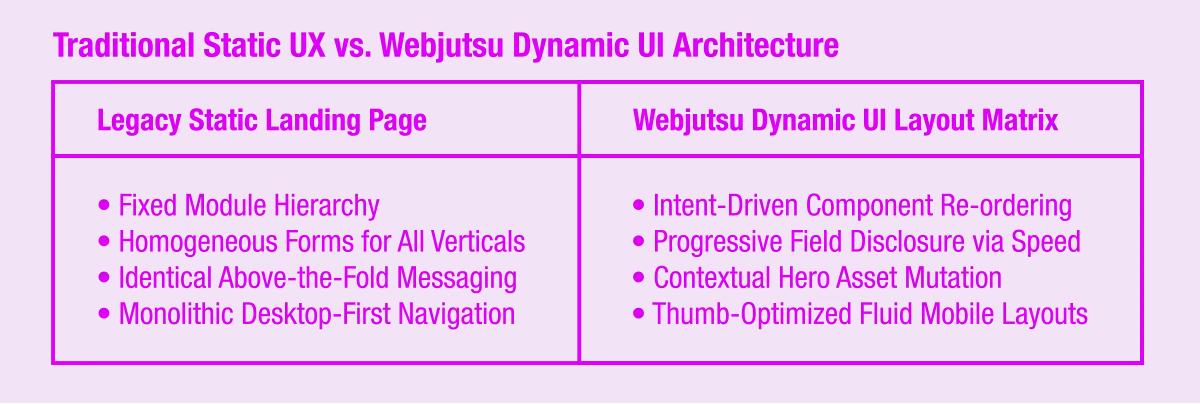
The Case Study: Dismantling the One-Size-Fits-All Model
To illustrate the concrete impact of real-time interface adaptation, let’s look at a comprehensive design study conducted by our creative technology team at Webjutsu Digital Media for an enterprise client experiencing a common marketing bottleneck: high paid-ad traffic, but an unyielding, stagnant 2.4% landing page conversion rate.
The client was running comprehensive ad campaigns targeting two vastly different buyer profiles:
- The “High-Urgency Fixer”: Users searching for instant technical deployment solutions to a broken corporate workflow.
- The “Researching Planner”: Long-tail researchers comparing architectural features for a rollout scheduled six months in the future.
The legacy site sent both profiles to a middle-of-the-road page. The “Fixers” left because they had to scroll through endless paragraphs of theoretical benefits to find the API documentation. The “Planners” left because the hard-sell conversion pop-ups felt overly aggressive before they even understood the core value proposition.
The Dynamic UI Strategy Implemented by Webjutsu
We rebuilt the architecture from the ground up using a modular component framework. Instead of building hardcoded HTML pages, we engineered fluid interface blocks that assembled themselves in under 150 milliseconds after a user’s link clicked through2.
1. Contextual Component Shifting (Above-the-Fold Optimization)
Our engineering team mapped out distinct, real-time layout configurations based on inbound UTM campaign parameters and historical user metadata:
- For the “High-Urgency Fixer”: The layout engine dynamically hid the decorative video background and heavy marketing prose. It immediately shifted a live sandbox console and a streamlined single-field “Deploy in 60 Seconds” input module directly above the fold.
- For the “Researching Planner”: The layout flipped completely. The technical sandbox dropped to the bottom of the page. Above the fold, the interface served a comprehensive feature matrix comparison layout, integrated independent trust badges, and surfaced a downloadable architectural whitepaper module.
2. Cognitive Load Management (The Frictionless Form)
A major conversion killer is decision fatigue. Research shows that reducing cognitive load and simplifying navigation paths are paramount to conversion optimization. Webjutsu deployed an adaptive form engine that assessed interactive signals on the fly3.
If a user exhibited slow, deliberate mouse movements or steady scroll speeds, the interface utilized progressive disclosure, displaying a detailed multi-step form that built trust through step indicators. If the user exhibited erratic, high-speed scrolling—classic signs of a mobile user multi-tasking or a panicked technical buyer—the form collapsed down into a swift, single-tap OAuth button (like “Sign up with Google”).
3. Mobile Thumb-Zone Restructuring
On mobile viewports, the system automatically repositioned interactive buttons and confirmation fields into accessible, thumb-friendly quadrants based on live device orientation data. Studies indicate that placing primary calls-to-action directly in the thumb-zone can lift mobile conversions by up to 43%3.
The Quantitative Results
The data collected over an extended testing window proved that treating users like a diverse ecosystem rather than a monolithic block yields immediate financial returns.
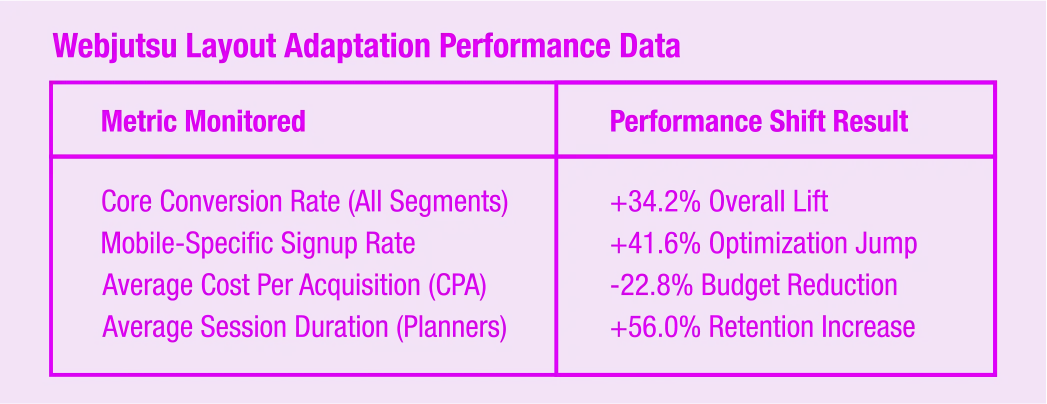
By allowing the page layout to react directly to real-time intent, overall conversion rates vaulted from 2.4% to 3.22%—a clean 34.2% total performance increase. Because the interface adapted itself to reduce friction instantly, the company saved thousands in monthly ad waste, dropping their acquisition costs by more than a fifth.
The Broader Reality: Data Benchmarks
Webjutsu’s findings line up perfectly with global macroeconomic data. Across the web design and marketing landscape, real-time personalization has evolved from a progressive design asset into an absolute commercial requirement.
A landmark Salesforce research dataset illustrated that companies mastering real-time behavioral personalization drove a 25% average higher conversion rate within the first six months of launch. Concurrently, deep-dive business optimization studies compiled by the Boston Consulting Group calculated that digital enterprises implementing smart, adaptive interfaces consistently experienced a 15% to 30% jump in overall digital sales over baseline performances2.
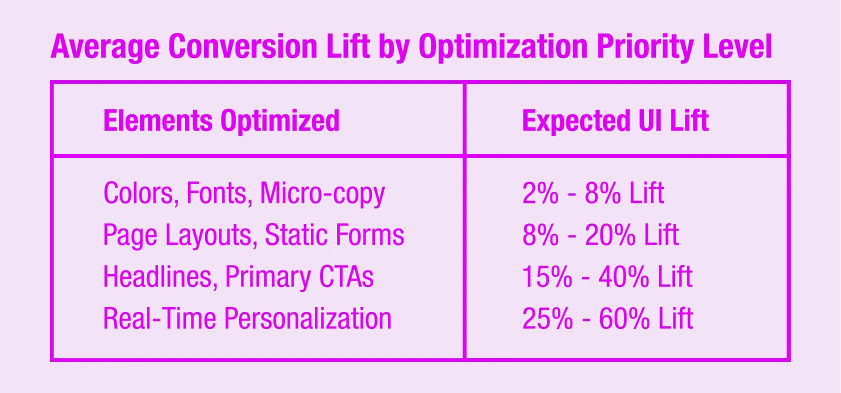
(Source: Claritus Solutions Conversion Optimization Matrix Framework)
Why are the returns on dynamic UI so heavily weighted? Because it strikes directly at human psychology. When a landing page shifts to mirror a customer’s thoughts in real time, it eliminates the cognitive friction of searching for information. The site feels intuitive, safe, and professional, meaning the user converts before they ever have a chance to get distracted and look elsewhere4.
The Webjutsu Dynamic Blueprint: Turning Traffic Into Revenue
Building an interface that transforms on the fly requires a sophisticated mix of clear data strategy, component-driven design patterns, and ultra-fast backend computing. If your business is ready to ditch static layouts and capture that 30%+ conversion lift, our engineering team uses a straightforward four-stage blueprint:
- Unified Intent Mapping: Before writing a single line of code, look at your traffic acquisition funnels. Map your ad campaigns and organic traffic routes into explicit psychological profiles (e.g., Value Hunters vs. Speed Seekers).
- Componentized Architecture Assembly: Design your website as a library of modular widgets rather than rigid pages. Every element—from testimonials to pricing blocks—needs to be a standalone block that can easily scale, hide, or move anywhere on the canvas.
- Millisecond Infrastructure Optimization: Ensure your analytics layer tracks user cues and passes them to your UI rendering engine instantly. In modern UX, even a one-second delivery lag can slice your overall conversion rate by 7%. Your system must run layout calculations seamlessly to prevent jarring visual jumps3.
- Continuous Behavioral Refinement: Use dynamic UI to run continuous, programmatic split-tests. Monitor interaction metrics, refine your layout variations, and let customer actions continually optimize your conversion loops4.
The era of demanding that customers adapt to your layout structure is gone. The future belongs to interfaces that adapt to them. Connect with Webjutsu Digital Media today, and let’s design an adaptive, high-converting digital experience that matches your audience’s needs perfectly.
- “The value of getting personalization right—or wrong—is multiplying” McKinsey & Company, (2021, November). https://mckinsey.com/
- “Personalization revolution: AI lifts conversions 25% while laggards lose trillions” Marketing Insider, (2024). https://marketing-insider.eu/
- “User experience design that converts: Complete guide 2025” Claritus Solutions, (2025, August). https://claritussolutions.com/
- “2025 UI trends that actually improve conversion rates” AlterSquare, (2025, August). https://altersquare.io/